Bimanual nonprehensile manipulation enables robots to move large or irregular objects that are
difficult to grasp, but reliable control remains difficult: success depends jointly on coordinated
contact, object dynamics, and kinematic feasibility. Learning these behaviors from teleoperated
demonstrations can be costly across diverse objects and goals. We present
Bimanual REconfiguration of Poses of Objects (BiREPO),
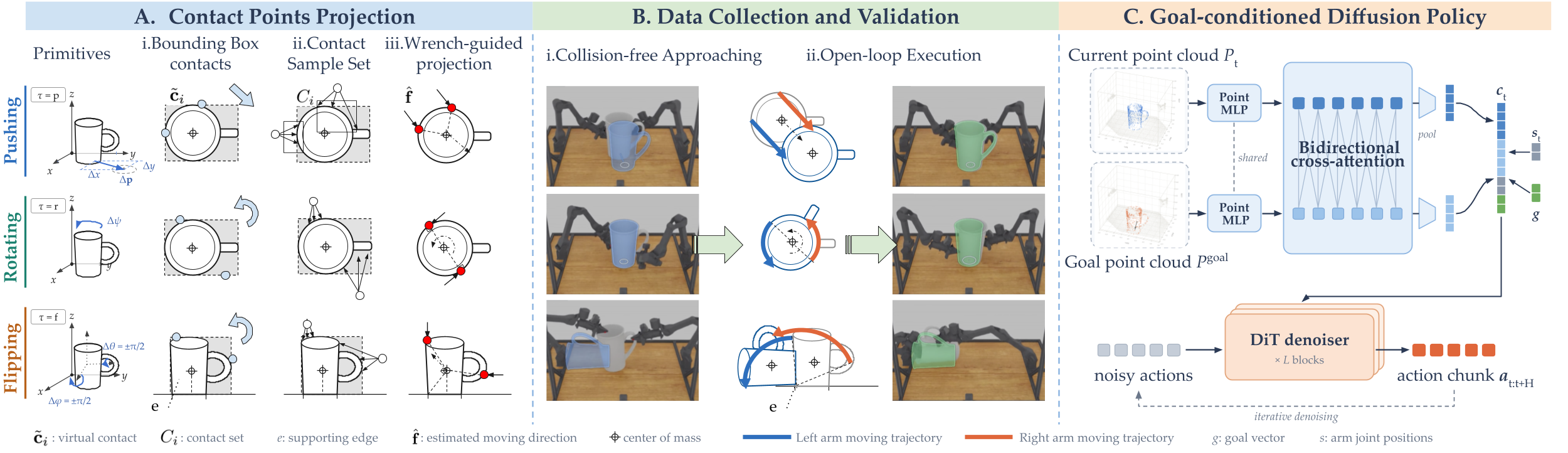
a framework for learning 3D bimanual nonprehensile primitives for pushing, rotating, and flipping
objects without human teleoperation. We begin with geometry-based scripted primitives designed for
regular shapes, then extend them to irregular (nonconvex) objects through a wrench-guided contact
projection that maps nominal contact points onto arbitrary surfaces while satisfying nonprehensile
objectives. We construct a data pipeline that validates candidate executions in simulation, and uses
successful trajectories to train one goal-conditioned diffusion policy per primitive, conditioned on
the current and goal object geometry and the requested pose change. In real-world experiments,
BiREPO achieves 65%, 63%, and 70% success on pushing, rotating, and flipping, respectively.
Furthermore, we demonstrate that the learned primitives can be chained together to achieve multi-step
object pose reconfiguration.